

A convincing pattern image is not automatically a seamless repeat tile. We generated six square designs in ChatGPT and repeated each original file three times across and three times down. That simple check exposed problems that were easy to overlook in a single swatch.
The results below are not a set of certified seamless downloads. The direct all-over prompts produced attractive illustrations with edge problems; the whole-motif fallback avoided cut icons but made the repeating blocks conspicuous. The night-sky design looked more forgiving at a glance, yet we would still inspect and repair it before treating it as an exact repeat.
What “seamless” needs to mean
In a straight repeat, the right edge of one tile meets the left edge of the next, and the bottom meets the top. A cut leaf must continue at the correct position and angle. Background color should not jump across the join. The junction where four copies meet matters too.
Even when those edges are unobtrusive, a design can show an obvious repeated block because of uneven spacing or a large empty lane. Edge continuity and an evenly distributed pattern are related checks, but they are not the same thing.
Two prompt methods tested
Cards 1–4 ask for a continuous all-over pattern. Motifs are allowed to cross an edge, so the opposite edge must supply the corresponding continuation. The prompts explicitly request this alignment.
Cards 5–6 use whole motifs with empty margins. This simpler fallback removes the need to join a cut flower or coffee pot. It also makes spacing harder: two empty margins combine into a wider gap between copies. These are intentionally different methods, not a controlled test that isolates one word in the prompt.
Six tiles and their actual repeats
In each card, the first image is the individual generated tile. The second is an actual 3×3 repeat made from exact copies of that tile. No image-generation step created the repeat preview, and no blending, overlapping, edge painting or seam repair was applied. We resized the complete grids for display.
Start by looking along the joins at one-third and two-thirds of each repeat image. Then step back and inspect the spacing. Open the image itself when you need a closer look; the small card view can conceal an alignment error.
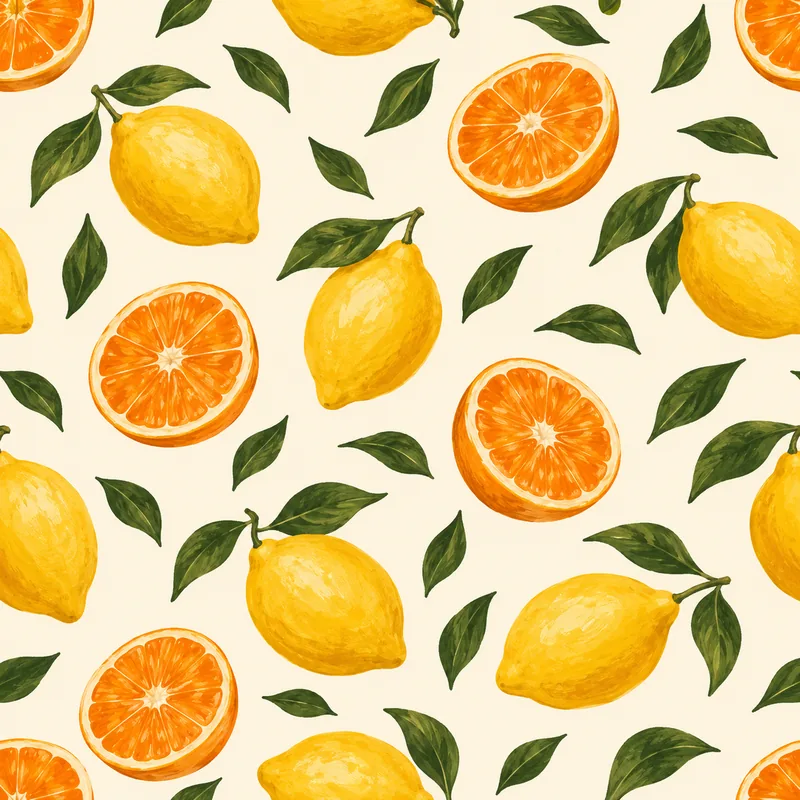
1. Citrus scatter
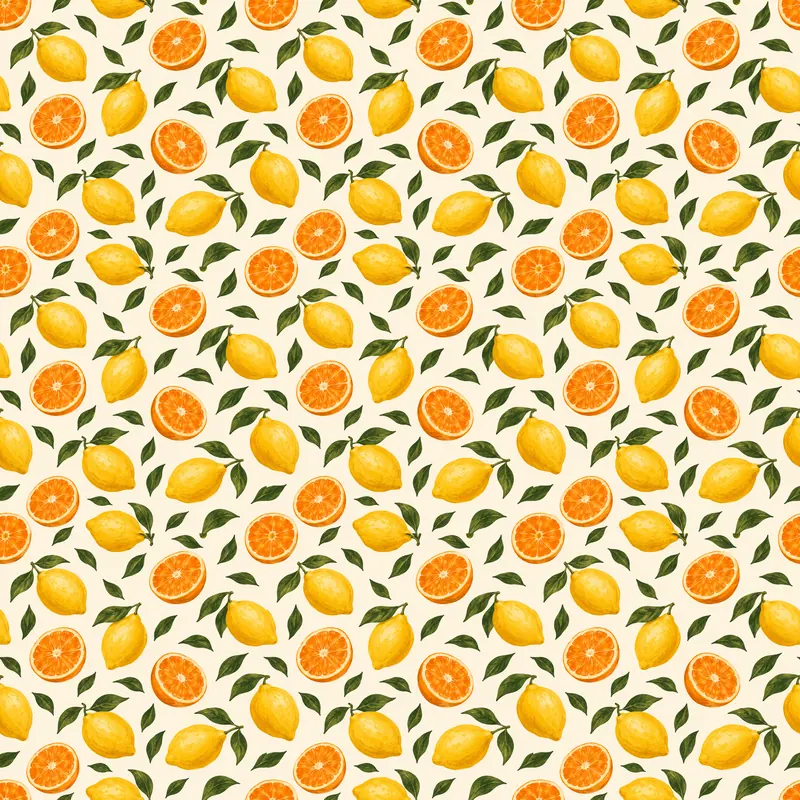
Observed result: The 3×3 repeat reveals mismatched fruit and leaf fragments at the tile boundaries. The citrus illustration is attractive, but this output does not pass the seamless-repeat check.
ACTUAL 3×3 REPEAT
FULL PROMPT
Create one square 1:1 repeat tile as a flat illustration, viewed straight on. This is the tile artwork itself, filling the entire image, not a mockup, not a multi-panel grid, not a swatch on a wall. No text, labels, watermark, border, lighting gradient, shadow or perspective. Use a warm ivory background with hand-painted yellow lemons, halved oranges and small dark green leaves. Make a seamless all-over repeating pattern: some motifs should cross the image boundaries, and each cropped motif must continue at exactly the matching position on the opposite edge. Match left to right and top to bottom in both position and color. Varied rotations and balanced medium spacing. Avoid a central focal point.
Practical tip: Trace every cut fruit across the opposite edge; a matching background alone is not enough.
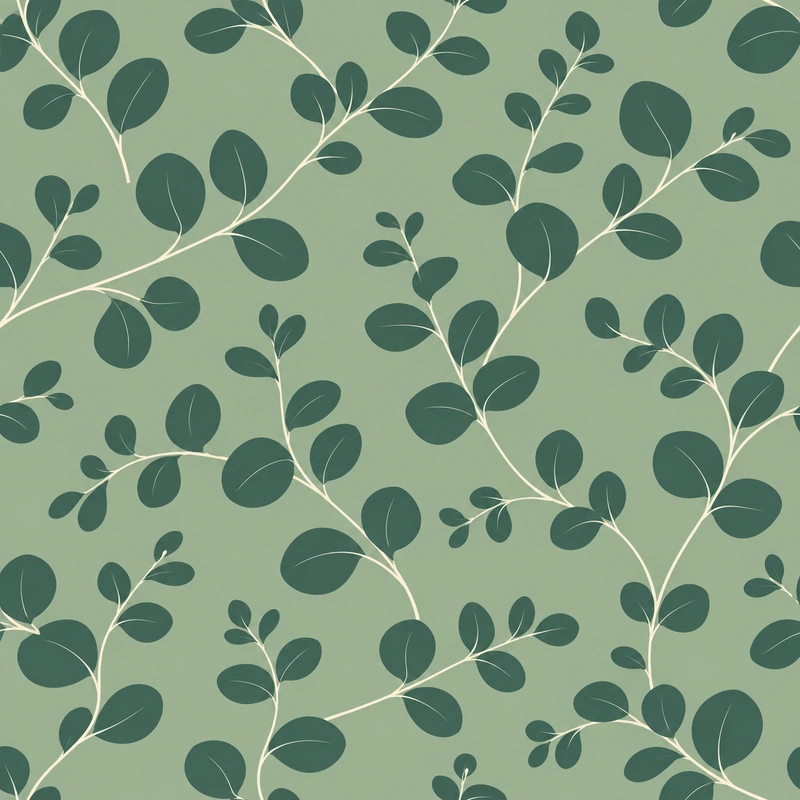
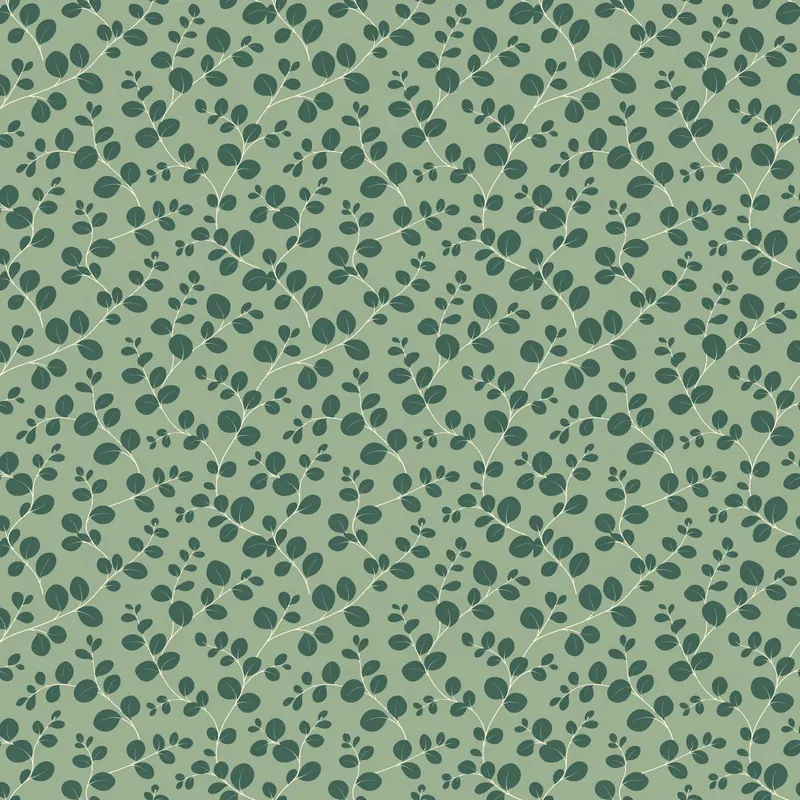
2. Botanical leaves
Observed result: The repeat has cut leaves and interrupted branches at the joins, plus a visible change in the sage background. Matching the general palette did not produce matching edge geometry.
ACTUAL 3×3 REPEAT
FULL PROMPT
Create one square 1:1 repeat tile as a flat illustration, viewed straight on. This is the tile artwork itself, filling the entire image, not a mockup, not a multi-panel grid, not a swatch on a wall. No text, labels, watermark, border, lighting gradient, shadow or perspective. Use a muted sage background and elegant flat dark-teal eucalyptus leaves with a few cream stems. Make a seamless all-over repeating pattern. Branches crossing any boundary must continue at exactly the corresponding location on the opposite boundary, with matching width, direction and color. Include varied branch directions and even density, not a wreath or a central bouquet.
Practical tip: Look for broken stems and doubled leaves where four tiles meet.

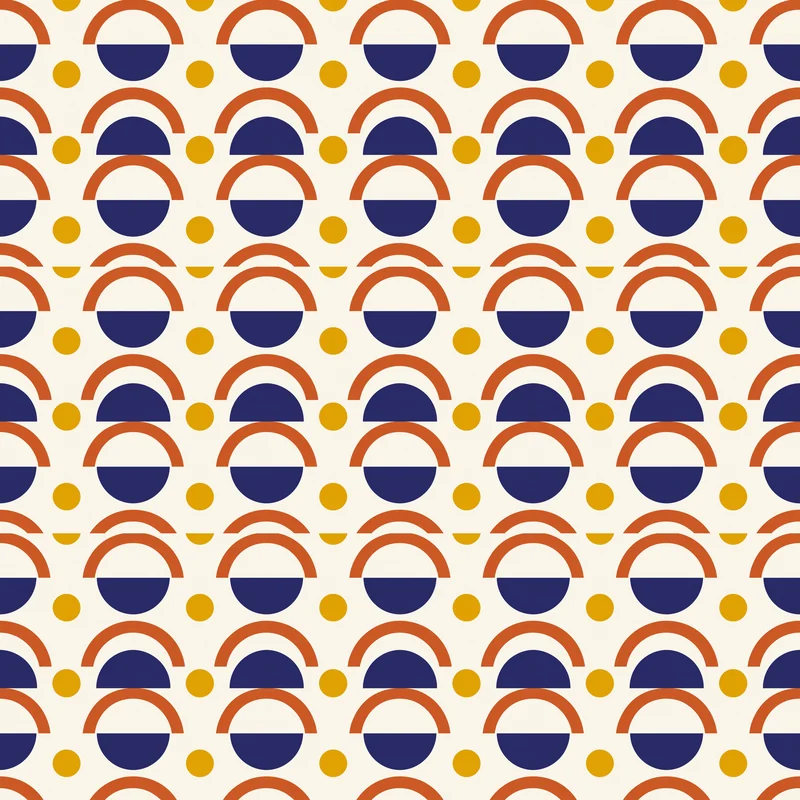
3. Geometric rhythm
Observed result: Horizontal joins cut through terracotta arcs and leave disconnected mustard fragments. Some vertical shapes join more convincingly, but failure on one axis is enough to reject this tile as seamless.
ACTUAL 3×3 REPEAT
FULL PROMPT
Create one square 1:1 repeat tile as a flat illustration, viewed straight on. This is the tile artwork itself, filling the entire image, not a mockup, not a multi-panel grid, not a swatch on a wall. No text, labels, watermark, border, lighting gradient, shadow or perspective. Use an off-white background and a crisp retro geometric pattern of indigo semicircles, terracotta arcs and mustard dots. Make a mathematically tileable all-over repeat. Any shape crossing an edge must align exactly with its counterpart on the opposite edge, with continuous outlines and no mismatched fragments. Keep spacing rhythmic but not concentrated in the center.
Practical tip: Simple shapes make small alignment errors easier to see; inspect both axes.

4. Night-sky stars
Observed result: The small stars and dark background make the overall repeat less distracting than the first three. Close inspection still shows small alignment and tonal inconsistencies; we do not certify it as an exact seamless tile.
ACTUAL 3×3 REPEAT

FULL PROMPT
Create one square 1:1 repeat tile as a flat illustration, viewed straight on. This is the tile artwork itself, filling the entire image, not a mockup, not a multi-panel grid, not a swatch on a wall. No text, labels, watermark, border, lighting gradient, shadow or perspective. Use a uniform deep navy background with small cream four-point stars, a few golden crescent moons and tiny dots. Make a seamless all-over repeat without a central focal point. Match every motif crossing an edge to its corresponding continuation on the opposite edge, and keep density even at tile boundaries.
Practical tip: A dark background can hide the seam at first glance; check the star spacing at each join.

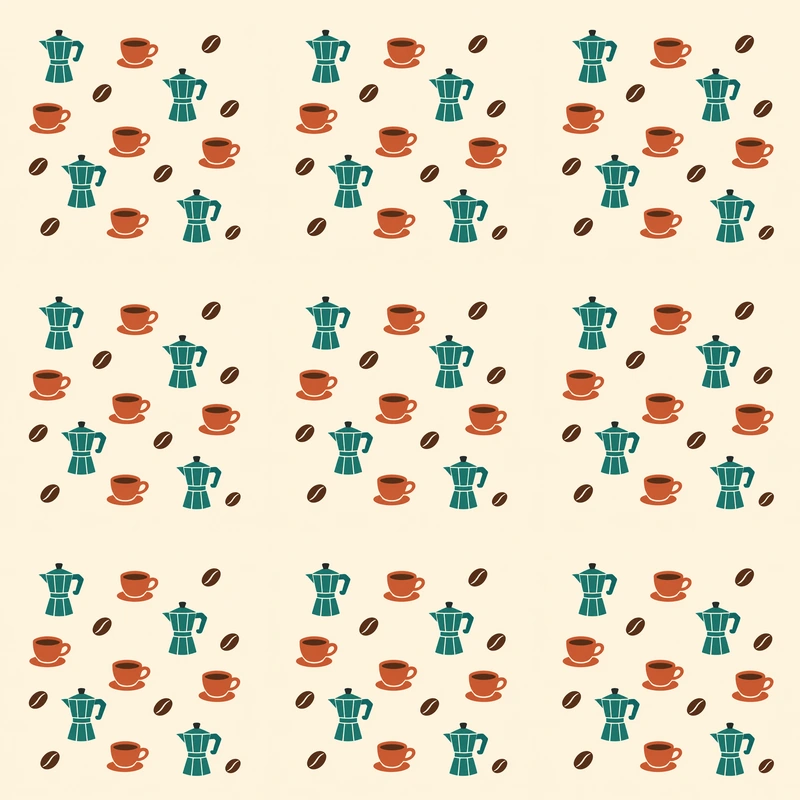
5. Coffee icons with clear edges
Observed result: The whole cups, beans and moka pots avoid chopped icons at the edges. However, the blank margins create wide repeated lanes, especially horizontally, so the block structure remains visible.
ACTUAL 3×3 REPEAT
FULL PROMPT
Create one square 1:1 repeat tile as a flat illustration, viewed straight on. This is the tile artwork itself, filling the entire image, not a mockup, not a multi-panel grid, not a swatch on a wall. No text, labels, watermark, border, lighting gradient, shadow or perspective. Use a perfectly uniform warm cream background. Draw small flat terracotta coffee cups, dark brown coffee beans and simple teal moka pots as a balanced scattered pattern. Every motif must be complete and entirely inside the central 84 percent of the canvas; leave a clear empty eight-percent margin along all four edges. The edge color must be identical on every side, with no shading, texture or vignette. Do not crop any motif. This intentionally uses whole icons and blank margins as a simple repeating-tile fallback.
Practical tip: Check whether the repeated empty margins form distracting lanes even when no icon is cut.
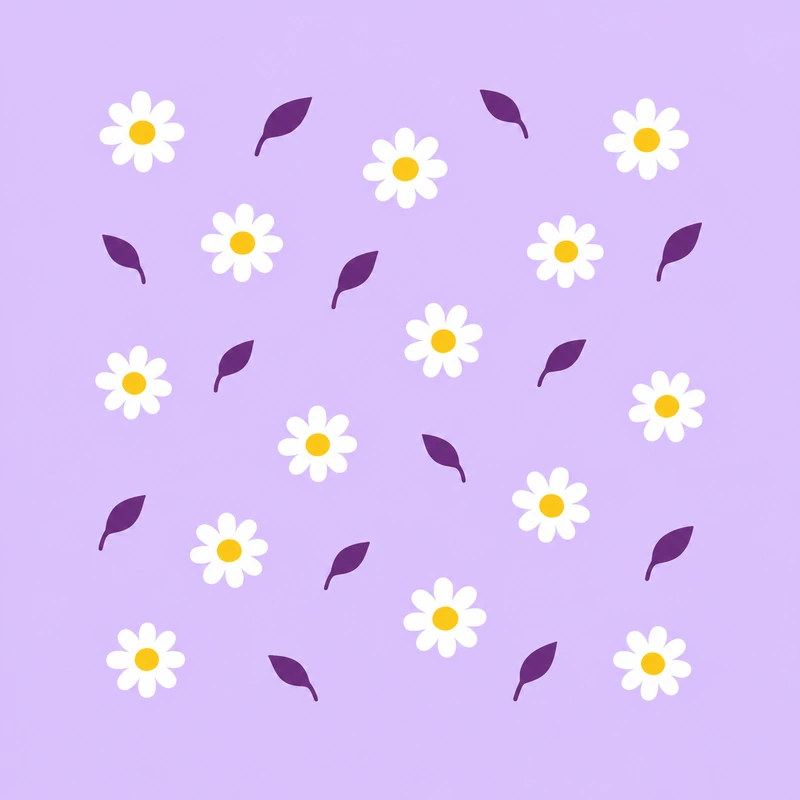
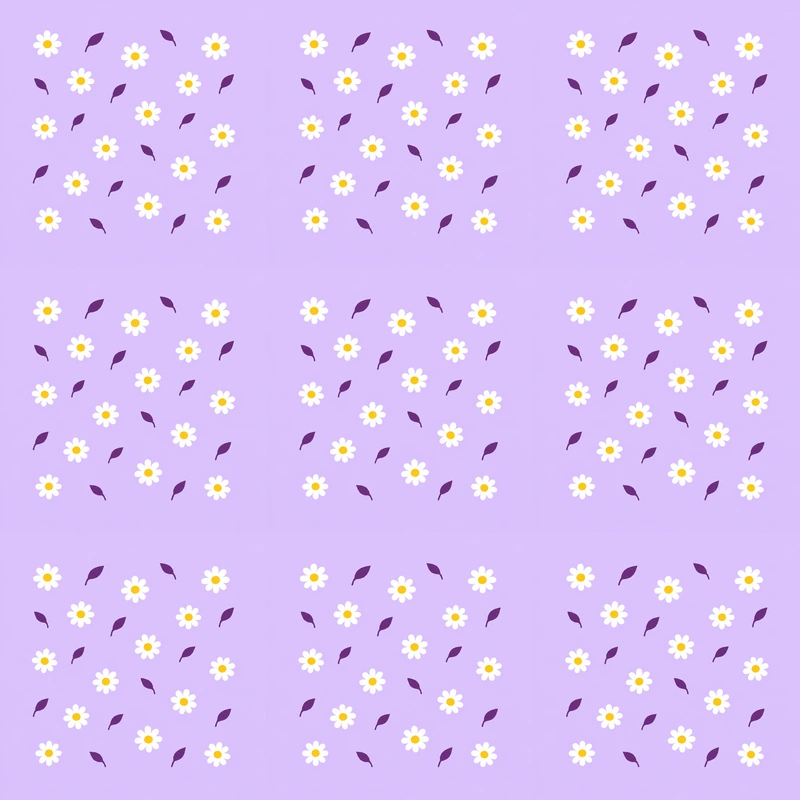
6. Simple flowers with clear edges
Observed result: The flowers and leaves stay whole, but the repeated empty margins form a clear grid of airy bands. The lavender field also has slight variation despite the request for a uniform fill.
ACTUAL 3×3 REPEAT
FULL PROMPT
Create one square 1:1 repeat tile as a flat illustration, viewed straight on. This is the tile artwork itself, filling the entire image, not a mockup, not a multi-panel grid, not a swatch on a wall. No text, labels, watermark, border, lighting gradient, shadow or perspective. Use a perfectly uniform pale lavender background. Draw a balanced scatter of small flat white daisies with golden centers and simple dark purple leaves. Every flower and leaf must be whole and stay inside the central 84 percent of the canvas; keep an empty eight-percent margin on every side. The solid edge color must be identical on all four sides, without paper texture, shadows or a vignette. No cropped petals. This intentionally uses whole motifs and blank margins as a simple repeating-tile fallback.
Practical tip: Continuous background does not guarantee an invisible tile: inspect repeated rows of empty space.
What the repeat checks actually showed
The citrus and leaf illustrations look like plausible pattern artwork when viewed alone. Once repeated, their cut motifs do not consistently reconnect. The geometric design makes the problem especially obvious: the horizontal boundary interrupts the arcs and mustard circles. A prompt saying “mathematically tileable” did not enforce the geometry in that generated file.
The night-sky tile is less conspicuous at the scale of the 3×3 overview because its motifs are small and the background is dark. That is a useful visual property, but it does not establish exact edge agreement. Small star alignment differences and tonal changes still warrant closer inspection.
The coffee and flower fallbacks avoid chopped objects. Their repeated empty margins, however, produce visible lanes. This may suit an intentionally spaced icon background; it does not demonstrate an evenly flowing all-over print. Both backgrounds also retain subtle variation despite the prompts requesting a flat fill.
Our conclusion: ChatGPT was useful for creating pattern concepts in this small test, but the word “seamless” in a prompt was not sufficient proof that a file could be repeated cleanly. These six outputs should be treated as inspected starting points, with their defects visible, rather than production-ready seamless assets.
How to check your own tile
- Save the actual generated file. Do not use a screenshot with padding or a cropped swatch from a larger mockup.
- Place nine exact copies in a 3×3 grid. Use the same dimensions and no gaps, overlap or blending.
- Inspect both vertical joins and both horizontal joins, including the four-tile intersections.
- Zoom in for cut outlines and color jumps, then zoom out for repeated empty bands and dense clusters.
- Repeat the check after any repair and again after the final resize. A different export can change thin details.
A convenient manual alternative is an image editor that can show a repeating canvas or move the outer edges to the center with an offset. The important part is viewing the actual neighboring pixels, not asking another generated image to imagine what the repeat might look like.
What to change when it fails
Broken motifs: simplify the artwork or rebuild the repeat in a design editor where elements crossing one edge can be duplicated to the opposite edge at an exact offset. If you regenerate, run the same repeat check again; a visually similar new tile can have different edge failures.
Visible background shifts: remove unnecessary gradients and texture from the prompt. If you replace the background with a measured flat color in an editor, describe that as a separate editing step. We did not apply such a correction to these files.
Blank lanes: the empty-margin fallback trades one problem for another. Reduce the margins or deliberately arrange the motif spacing as a regular icon grid. Smaller gaps are a suggested next iteration, not a tested fix shown here. A half-drop layout is also a different repeat system and needs its own matching edges and verification; merely staggering a broken tile is not evidence of a repair.
Complexity hiding the seam: a busy illustration can distract from an incorrect join. Check simple landmarks, such as one leaf stem or one circle, rather than judging only the overall attractiveness. If a design must be exact, keep the original file and the repeat check together.
Where these concepts are useful
They can help choose a palette, motif family or graphic direction for a background. They are not print-tested fabric files, vector artwork or verified wallpaper production assets. No physical print, color proof or manufacturing test was performed, and an 800-pixel web preview is not a statement about print size or resolution.
For standalone motifs rather than repeating surfaces, our transparent sticker examples show a different workflow and an actual alpha-channel check. For broader visual directions, see 30 image style prompts. A style transformation and an exact repeat solve different problems.
Method and limitations
We generated six separate square PNG tiles in ChatGPT on 27 November 2026, one attempt per tile. Each used its full prompt independently; none was cut from a generated contact sheet. The featured cover was generated separately as a concept illustration and is not a seam-test result.
We used Python with Pillow to paste nine exact copies of each original 1254 × 1254 file into a 3762 × 3762 canvas. The script checked that each of the nine pasted regions was pixel-identical to its source before export. We visually inspected the six repeats and enlarged horizontal and vertical join strips. That verifies how the previews were constructed; it is not a numerical certification that a pattern is seamless.
The original tiles and repeat previews were converted to 800 × 800 WebP for the website without cropping the artwork. The grids were resized as complete images. No generative repair, edge blending or manual rearrangement was performed. We also inspected the exported previews; small errors can still be harder to see in reduced images than in the originals.
This is a six-output test, not a measurement of every possible generation or a claim that ChatGPT can never make a seamless pattern. We cannot verify the exact model identifier or per-image credit cost from the interface used, so neither is reported. For the official creation workflow, see OpenAI’s ChatGPT Images help page.