

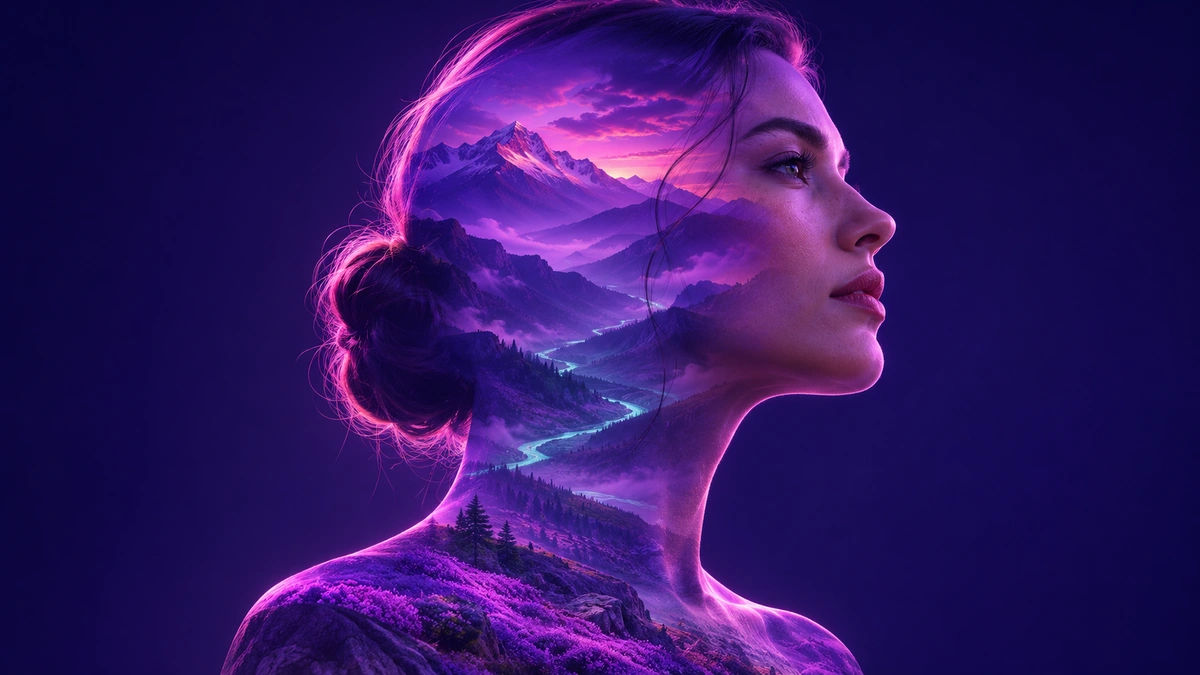
A useful double-exposure prompt names two things: the outer silhouette you want to keep and the scene you want inside it. Without that relationship, an image may become an ordinary portrait in front of a landscape or a busy texture painted across the face.
We used one fictional adult profile to create eight separate landscape blends in ChatGPT. Every result below has its full prompt, an observed result and one practical adjustment. These are generated interpretations of a photographic effect, not photographs made with multiple camera exposures.
Our source profile
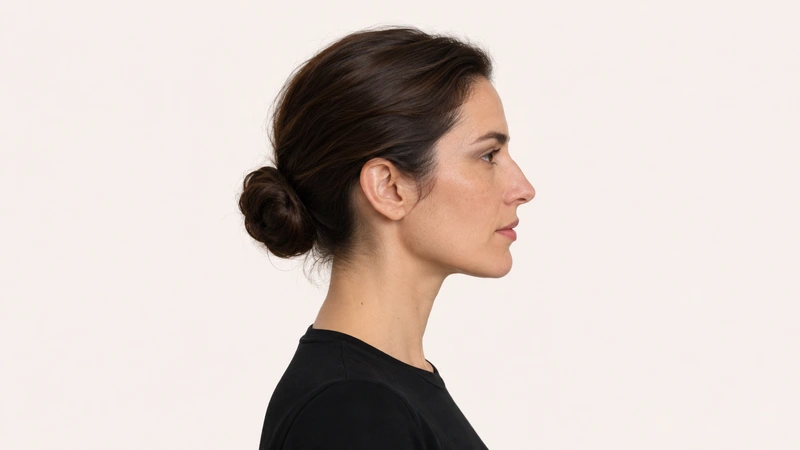
The plain background and right-facing outline give the generator a clear boundary. Download or save this source image if you want to follow the same reference-based workflow. The person is fictional and was generated for this article.
Exact source-generation prompt
Create one realistic studio portrait of an original fictional adult woman aged about 35 in strict right-facing side profile. Dark brown hair in a compact low bun, straight nose, calm neutral expression, black crew-neck top. Head, bun, neck and upper shoulders fully inside the image with generous blank margins. Pale warm-white seamless background, soft controlled studio light, crisp recognizable outline from forehead to nose, lips, chin and neck. No other faces, no landscape, no jewelry, no lettering, no logos, no watermark or border. Horizontal 16:9 composition, subject centered, enough empty space to see the complete silhouette. This is a fictional editorial reference, not a celebrity.
Make the silhouette do the work
- Choose a clear profile with the head and hair fully visible. Use your own image, a permitted reference or a fictional character you create.
- Attach the original source to each request. Specify the direction of the face and the outline you want to preserve.
- Place the landscape inside the silhouette and keep the outside field simple. Name the area where the busiest detail should sit.
- Inspect the result small before adding fine details. The nose and chin should still read as one profile.
OpenAI’s image help covers using an uploaded image for edits. A reference guides the result; it does not guarantee exact facial identity. For identity-led projects, see our character consistency guide.
Eight landscape blends to copy and adapt
Attach the source profile above before running any of these prompts. Each selected picture was generated separately from that source, rather than from the preceding edited result.
1. Forest at dawn
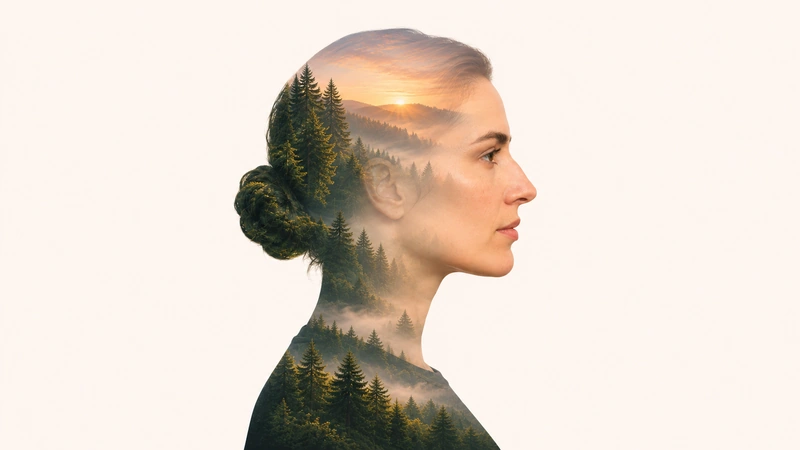
Observed result: The forest fills the bun, back of the head and shoulders, while the face remains relatively clear. The outer profile stays readable against the pale field.
FULL PROMPT
Use the attached fictional woman's profile as the subject reference. Create one original double-exposure portrait, keeping a single right-facing profile with a compact low bun and a clearly readable forehead, nose, lips, chin, neck and upper shoulders. The complete head and shoulder silhouette must fit within a horizontal 16:9 frame with generous margins. Blend the following landscape inside the silhouette, while the outside stays a clean warm-white field. Keep the outer contour crisp, with the internal scene softer near the facial area. No second face, extra eye, text, logos, border or watermark. Tall evergreen trees with a low layer of pale mist and warm dawn light. Put the densest forest texture inside the back of the head and shoulders, leaving the nose and forehead contour simple.
Practical tip: Keep tree trunks away from the tip of the nose so the profile remains readable.
2. Ocean waves
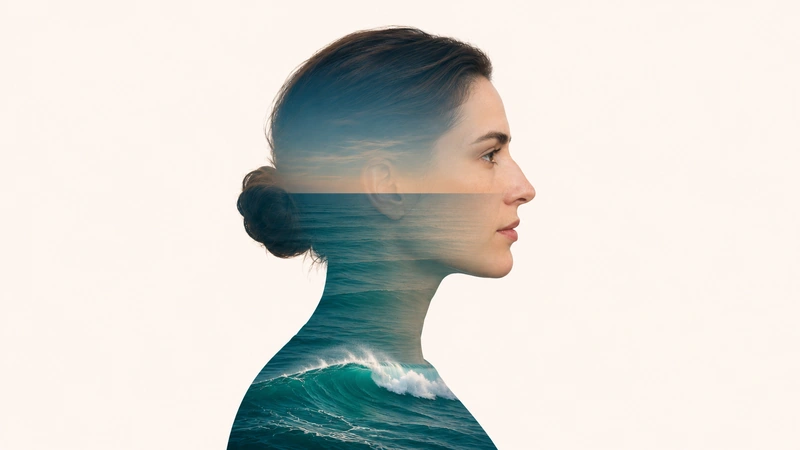
Observed result: The main crest sits across the shoulder and the horizon runs inside the head. The sharp horizon line is visible through the portrait, so a softer transition may suit a subtler version.
FULL PROMPT
Use the attached fictional woman's profile as the subject reference. Create one original double-exposure portrait, keeping a single right-facing profile with a compact low bun and a clearly readable forehead, nose, lips, chin, neck and upper shoulders. The complete head and shoulder silhouette must fit within a horizontal 16:9 frame with generous margins. Blend the following landscape inside the silhouette, while the outside stays a clean warm-white field. Keep the outer contour crisp, with the internal scene softer near the facial area. No second face, extra eye, text, logos, border or watermark. A turquoise ocean with one cresting white wave across the shoulder area and a quiet horizon inside the head. Deep blue-green water, restrained foam, natural ocean texture, no scenery outside the figure.
Practical tip: A clear wave shape reads better than foam spread over the entire face.
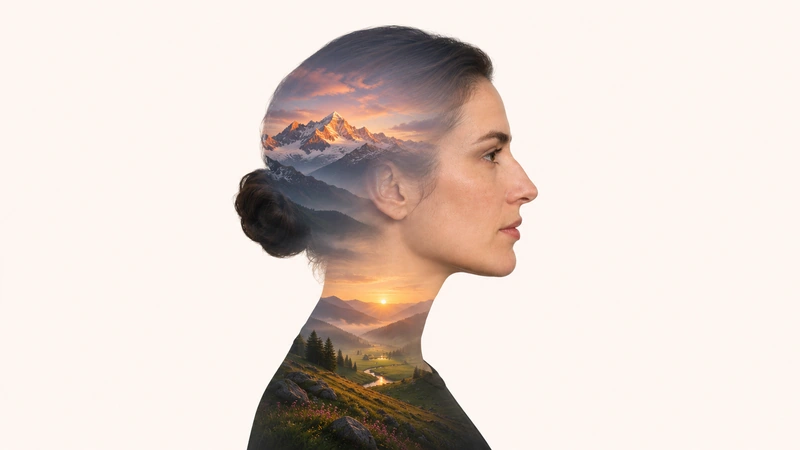
3. Mountain sunrise
Observed result: Peaks fill the upper head and a valley fills the shoulders. Two sunrise-like bright regions appear at different levels; it is an attractive blend, but not one geographically coherent landscape.
FULL PROMPT
Use the attached fictional woman's profile as the subject reference. Create one original double-exposure portrait, keeping a single right-facing profile with a compact low bun and a clearly readable forehead, nose, lips, chin, neck and upper shoulders. The complete head and shoulder silhouette must fit within a horizontal 16:9 frame with generous margins. Blend the following landscape inside the silhouette, while the outside stays a clean warm-white field. Keep the outer contour crisp, with the internal scene softer near the facial area. No second face, extra eye, text, logos, border or watermark. Layered alpine peaks and a small valley at sunrise inside the profile, with warm light on the highest ridge. Place the ridge inside the back of the head rather than across the outer face contour.
Practical tip: Separate the mountain ridge from the forehead outline rather than letting them compete.
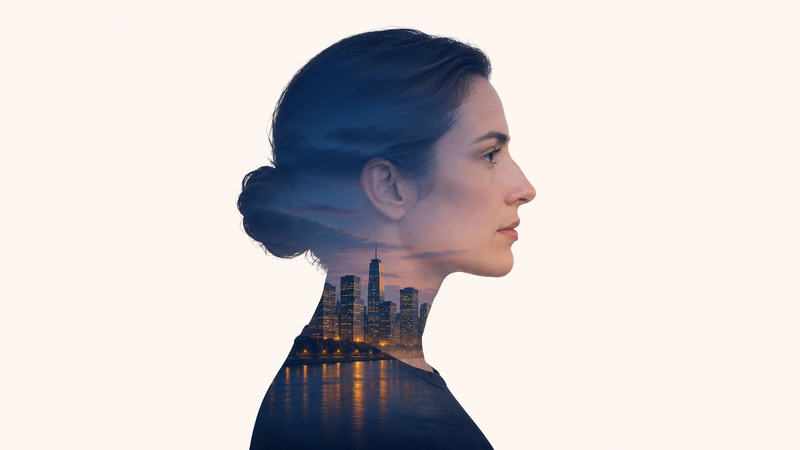
4. Night city
Observed result: The city is concentrated around the neck and shoulder, with a quieter dark sky inside the head. The face remains visible rather than becoming a second city-shaped face.
FULL PROMPT
Use the attached fictional woman's profile as the subject reference. Create one original double-exposure portrait, keeping a single right-facing profile with a compact low bun and a clearly readable forehead, nose, lips, chin, neck and upper shoulders. The complete head and shoulder silhouette must fit within a horizontal 16:9 frame with generous margins. Blend the following landscape inside the silhouette, while the outside stays a clean warm-white field. Keep the outer contour crisp, with the internal scene softer near the facial area. No second face, extra eye, text, logos, border or watermark. An original city skyline at blue hour, small warm window lights and a dark indigo sky inside the silhouette. Keep buildings below the upper head boundary, with a quieter face area. No readable signs or brands.
Practical tip: Keep tiny windows subordinate to the large profile silhouette.
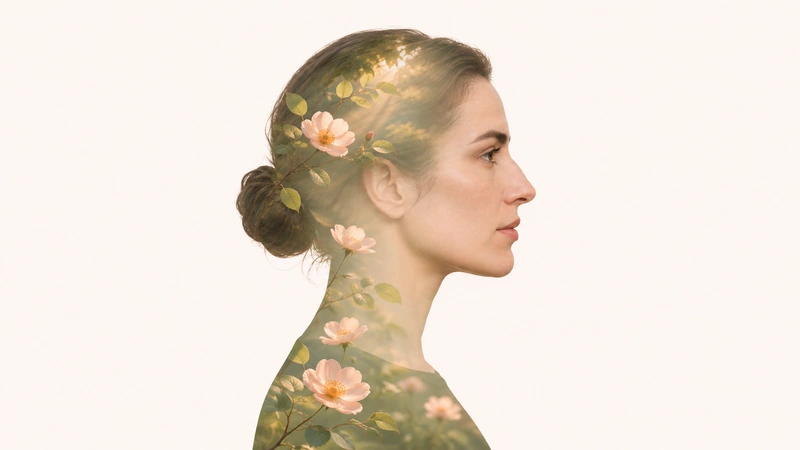
5. Flower garden
Observed result: Peach flowers and foliage occupy the back of the head and shoulder with useful gaps. The flowers stay within the main silhouette instead of forming an external crown.
FULL PROMPT
Use the attached fictional woman's profile as the subject reference. Create one original double-exposure portrait, keeping a single right-facing profile with a compact low bun and a clearly readable forehead, nose, lips, chin, neck and upper shoulders. The complete head and shoulder silhouette must fit within a horizontal 16:9 frame with generous margins. Blend the following landscape inside the silhouette, while the outside stays a clean warm-white field. Keep the outer contour crisp, with the internal scene softer near the facial area. No second face, extra eye, text, logos, border or watermark. An airy garden of pale peach flowers and soft green leaves inside the head and shoulders, with gentle morning light. Use generous gaps among the blossoms, not a dense floral wallpaper. No flowers growing outside the outline.
Practical tip: Ask for space between blooms when the result starts looking like a floral mask.
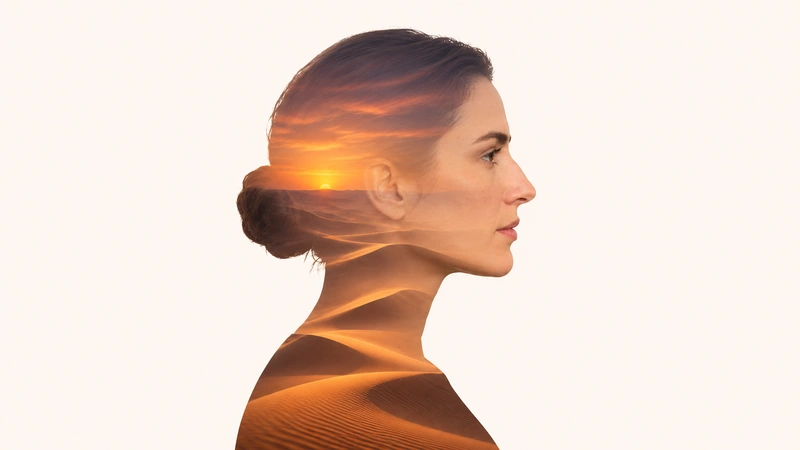
6. Desert dunes
Observed result: Large dune curves read clearly through the neck and shoulders. The warm treatment changes the portrait's overall color as well as adding scenery.
FULL PROMPT
Use the attached fictional woman's profile as the subject reference. Create one original double-exposure portrait, keeping a single right-facing profile with a compact low bun and a clearly readable forehead, nose, lips, chin, neck and upper shoulders. The complete head and shoulder silhouette must fit within a horizontal 16:9 frame with generous margins. Blend the following landscape inside the silhouette, while the outside stays a clean warm-white field. Keep the outer contour crisp, with the internal scene softer near the facial area. No second face, extra eye, text, logos, border or watermark. Smooth ochre sand dunes with long soft shadow curves at sunset, their ridges flowing inside the shoulder and back of the head. Keep the warm-white outside field completely clean.
Practical tip: Simple dune curves are useful when detailed scenes obscure the face.
7. Star-filled sky
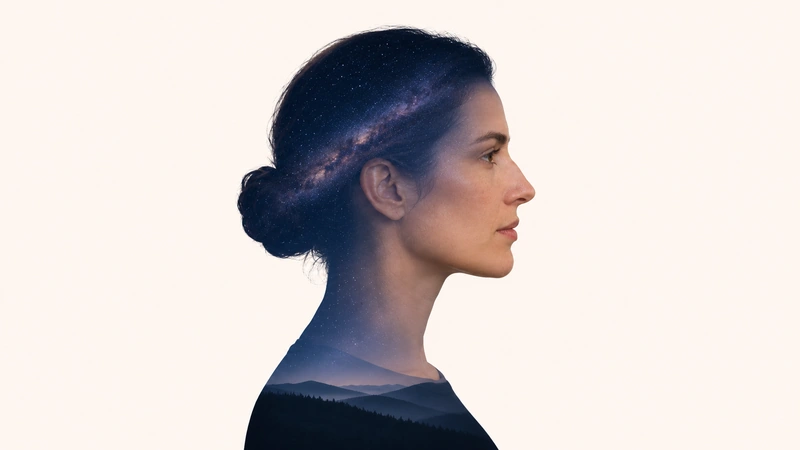
Observed result: The star field and Milky Way sit mainly inside the hair area, with a dark ridge across the shoulder. The face is darker and cooler, but there is still only one profile.
FULL PROMPT
Use the attached fictional woman's profile as the subject reference. Create one original double-exposure portrait, keeping a single right-facing profile with a compact low bun and a clearly readable forehead, nose, lips, chin, neck and upper shoulders. The complete head and shoulder silhouette must fit within a horizontal 16:9 frame with generous margins. Blend the following landscape inside the silhouette, while the outside stays a clean warm-white field. Keep the outer contour crisp, with the internal scene softer near the facial area. No second face, extra eye, text, logos, border or watermark. A restrained star-filled deep navy night sky and a subtle band of the Milky Way inside the silhouette, with a low dark ridge across the shoulders. No planets, bright lens flares or stars outside the profile.
Practical tip: Place the brightest region behind the head rather than over the eye area.
8. Winter woodland
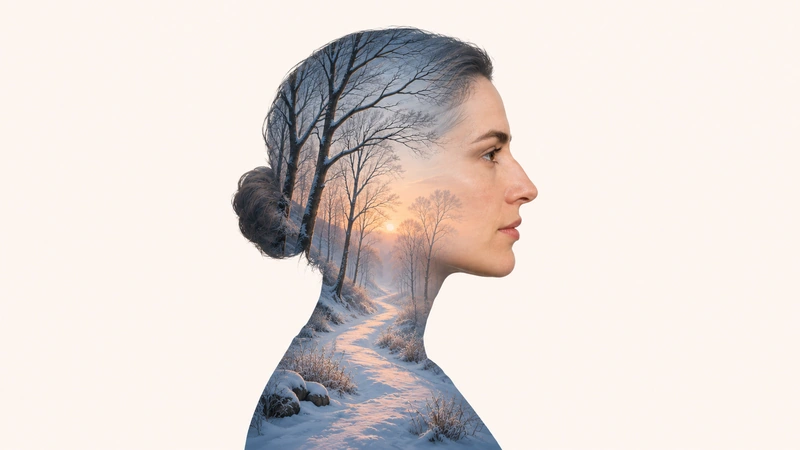
Observed result: The snowy path and tree trunks retain blue-grey contrast inside the pale profile. Darker branches keep the interior distinguishable from the clean outside field.
FULL PROMPT
Use the attached fictional woman's profile as the subject reference. Create one original double-exposure portrait, keeping a single right-facing profile with a compact low bun and a clearly readable forehead, nose, lips, chin, neck and upper shoulders. The complete head and shoulder silhouette must fit within a horizontal 16:9 frame with generous margins. Blend the following landscape inside the silhouette, while the outside stays a clean warm-white field. Keep the outer contour crisp, with the internal scene softer near the facial area. No second face, extra eye, text, logos, border or watermark. Slender bare trees and a quiet snowy path inside the silhouette, soft blue-grey shadows and a little pale sunrise warmth. Preserve enough internal contrast that the snowy scene does not disappear into the warm-white outside field.
Practical tip: Snow needs a visible tonal boundary; white inside white can erase the silhouette.
What kept these portraits readable?
The strongest separation comes from keeping a clean outer field and moving the busiest landscape detail toward the back of the head or shoulder. In our forest example, the trees occupy the bun and neck while the nose contour stays quiet. The city example uses the same idea with buildings lower in the figure.
A double exposure can preserve visible facial features or reduce the person to a darker silhouette. Our prompts favored the first option. If you want a graphic silhouette, ask for less skin detail and stronger separation between the outline and background. That is a suggested adaptation, not another tested result in this set.
Three problems to fix before adding more detail
The scene is behind the person. Restate that the landscape belongs inside the head-and-shoulder boundary, with a plain field outside. Ask for one profile instead of a general portrait collage.
The face becomes muddy. Reduce the number of competing elements. Use one wave, one ridge or a few large flowers, and place the highest contrast away from the nose and eye. A recognizable outline matters more than including every leaf.
The landscape creates conflicting horizons. Our mountain result contains two sunrise-like bright areas. If that conflicts with your goal, ask for one light source and a single continuous horizon inside the figure. The displayed result is the actual generation; we did not manually rebuild its interior scene.
Choose the level of contrast for the final size
The winter example needs dark tree branches and blue-grey snow shadows to remain visible against the light outside field. The star example creates separation more easily with a dark interior, but the portrait also becomes cooler and darker. Check that tradeoff at your intended display size instead of assuming more contrast is always better.
For other impossible image ideas, explore our surreal image prompts. For a different problem—where light comes from rather than what fills a silhouette—use our lighting prompt examples.
How these examples were produced
AI Revolution created the fictional source, eight reference-based blends and a separate conceptual cover directly in ChatGPT on 27 November 2026. Each asset took one generation attempt: ten calls in total. No external portrait or landscape photographs were supplied. We inspected the outlines, checked for extra faces and reviewed the main landscape placement. The examples were resized as complete images to 800 × 450 WebP; we did not crop small pictures out of a generated grid.
The tool did not expose the exact image model identifier or per-image credit cost. These images demonstrate art direction, not a measured guarantee of identity preservation. Keep the outline readable, give the inner scene one clear focal element, and treat changes in the face as something to inspect rather than accept automatically.